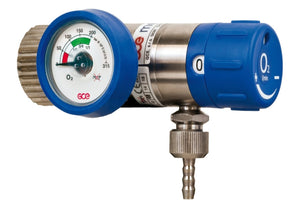
A pressure reducer for medical oxygen must match the cylinder, the required flow, and the connected application. In this category, you will find adjustable and fixed oxygen pressure reducers from GCE and HUM AEROway for professional applications in practices, clinics, emergency medical services, and emergency equipment.
Pressure Regulators for Medical Oxygen – GCE & AEROway
Four points are crucial for selection: cylinder connection, permissible inlet pressure, flow range or outlet pressure, and connection of the subsequent application. A higher maximum flow is not automatically better – it is more important that the required range can be set appropriately and safely.
Selection guide: GCE Mediselect, AEROway Fast, Fine or Fix?
Model Family
Characteristic
Typical selection in the shop
GCE Mediselect II
adjustable flow
0–2, 0–6 or 0–25 l/min; additionally, variants with different outlets/connections
GCE MediReg 100
fixed flow or defined outlet pressure
e.g., 4 l/min or 4.5 bar and connection variants
AEROway Fast
compact flow pressure reducers
Variants up to 1, 5, 15 or 50 l/min; partly with additional connection
AEROway Fine
more finely graduated flow control
Versions up to 15 or 30 l/min
AEROway Fix
fixed flow or defined outlet
Fix I 4 l/min and Fix II with 4.5 or 5
The exact connection and pressure specifications can always be found on the respective product page. For existing cylinders or devices, compatibility should be checked before ordering.
Adjustable flow or fixed flow?
An adjustable flow pressure reducer is useful when different flow rates are needed. A fixed flow is suitable where a constant flow rate is intended. For certain medical devices, however, a defined supply pressure is required instead of a flow outlet.
What do 200 bar and 300 bar mean?
The pressure reducer must be approved for the maximum cylinder pressure and the respective cylinder connection. A model designed for 200 bar may not automatically be used on a 300 bar cylinder. Pressure rating and mechanical connection must match.
What should you know about “Pressure reducers for masks and nasal cannulas”?
For oxygen administration via an oxygen mask or nasal cannula, a suitable flow outlet is typically required. Tubing, patient connection, and set flow must match the intended application.
What should you know about “Pressure reducers for medical devices”?
Suction devices, ventilation systems, or other medical devices may require a defined inlet pressure and a specific connection. In such cases, selection should not be based solely on the liter-per-minute value. The technical specifications of the connected device are decisive.
When is a separate pressure reducer not required?
For oxygen cylinders with an integrated combi-valve, pressure reduction and flow control may already be included in the valve. An example is our 2-liter oxygen cylinder with MediVitop combi-valve. In this case, a separate classic pressure reducer is not required for the intended flow delivery.
What should you know about “Calculate oxygen supply and run time”?
The manometer shows the cylinder pressure. For a rough run time, cylinder volume and flow must also be taken into account. A 2-liter cylinder at 200 bar contains approximately 400 liters of gas. At 4 l/min, this calculates to roughly 100 minutes.
What should be observed for safe operation?
Pressure reducers are safety-relevant components. Oxygen-carrying components must consistently remain free of oil and grease. Damaged, leaking, or conspicuously operating pressure reducers must not be used further. Maintenance and inspection intervals are based on manufacturer specifications. Further information can be found in the guide to pressure reducer maintenance.
What should you know about “Assemble a complete oxygen system”?
Unsure about connection, flow, or outlet pressure? For technical classification, please have the cylinder size, valve connection, and desired application ready. Technical assistance: 05071 5329670.